There is a moment in a New Orleans jazz funeral when everything changes. The procession begins in silence — slow, solemn, the brass band playing a dirge as the casket moves through the streets. And then, after the burial, something shifts. The music quickens. The umbrellas open. People begin to dance. The mourners become celebrants, and the street that was carrying grief suddenly carries something else entirely — the full, complicated, joyful weight of a life that was lived.
This is called the "second line." And it is one of the most honest things any funeral tradition has ever produced.
Around the world, in cultures that have had time to develop their relationship with death into something more nuanced than silence and dark clothing, the idea that a funeral should celebrate a life — not just mark its end — is not unusual. It is the norm. What is unusual, in much of modern American life, is the assumption that grief must be quiet, contained, and over quickly.
How the World Says Goodbye
The New Orleans jazz funeral is perhaps the most famous example of a celebratory funeral tradition in America, but it is far from the only one. Across cultures and centuries, people have found ways to honor the dead that look more like a party than a procession — and in doing so, have created something that genuinely helps the living.
In Ghana, fantasy coffins are crafted in the shape of the things a person loved in life — a fisherman might be buried in a coffin shaped like a fish, a farmer in one shaped like a cocoa pod, a pilot in a small airplane. The coffins are works of art, often brightly colored, and the funerals that accompany them are community celebrations that can last for days. The message is unmistakable: this person had a whole life, and it mattered in a specific way.
In Mexico, Día de los Muertos — the Day of the Dead — turns grief into an annual reunion. Families build elaborate altars for their loved ones, fill them with photographs and favorite foods and objects that mattered to the deceased, and gather to remember them with music, candles, and marigolds. Death is not the end of the relationship. It is simply a change in how it continues.
In parts of Indonesia, the Torajan people hold funerals that can last for days and include communal feasts and ceremonies that celebrate the deceased's journey to the afterlife. The longer and more elaborate the funeral, the greater the honor paid to the person who died.
In Ireland, the wake tradition — gathering around the body of the deceased, telling stories, laughing and crying together through the night — has always understood that grief is communal, and that honoring someone means telling the truth about who they were, including the funny parts.
"Every culture that has lived close to death has found a way to make the farewell worthy of the life. The jazz funeral just happens to do it loudest."
What these traditions share is not irreverence — it is the opposite. They are deeply reverent, in the truest sense of the word. They take the life that was lived seriously enough to honor it with everything they have. Color. Music. Food. Stories. Movement. Joy alongside grief, not instead of it.
What the Jazz Funeral Actually Is
The New Orleans jazz funeral grew from the intersection of West African musical traditions, French Catholic funeral customs, and the particular culture of Black New Orleans in the 19th century. The brass bands that played at funerals were not decoration — they were participants in the grief, leading the community through it with music that could hold both sorrow and celebration simultaneously.
The structure of the jazz funeral mirrors the structure of grief itself. First comes the hard part — the slow march, the minor keys, the weight of loss. Then comes the release. The second line, the dancing, the music that says: this person lived. They are gone and we are here and life goes on and that is both terrible and beautiful and we are going to feel all of it right now, together, in the street.
It is one of the most psychologically sophisticated funeral traditions ever developed. And it belongs, in its bones, to Louisiana.
A True Story: Louisiana Roots, Austin Soil
A team of white horses with custom tan plumes. A jazz band walking behind the hearse. A procession through East Austin that stopped everyone who saw it.
In September 2025, we were called to Evergreen Cemetery on East 12th Street in Austin, Texas, to carry a woman home. She had been born in Natchitoches, Louisiana — deep in the heart of a state that knows how to say goodbye — and had spent her life in Austin raising her family, working in nursing and special education, and pouring herself into the people around her for more than seven decades.
Her son wanted her farewell to reflect all of that. He ordered a full team of white horses — not a single horse, but a team, the kind of presence that commands a street. He chose custom tan plumes, dyed to coordinate with the color palette of her service, mounted on the horses' bridles. Our drivers dressed in coordinating attire. And behind the horse-drawn hearse, a jazz band walked.
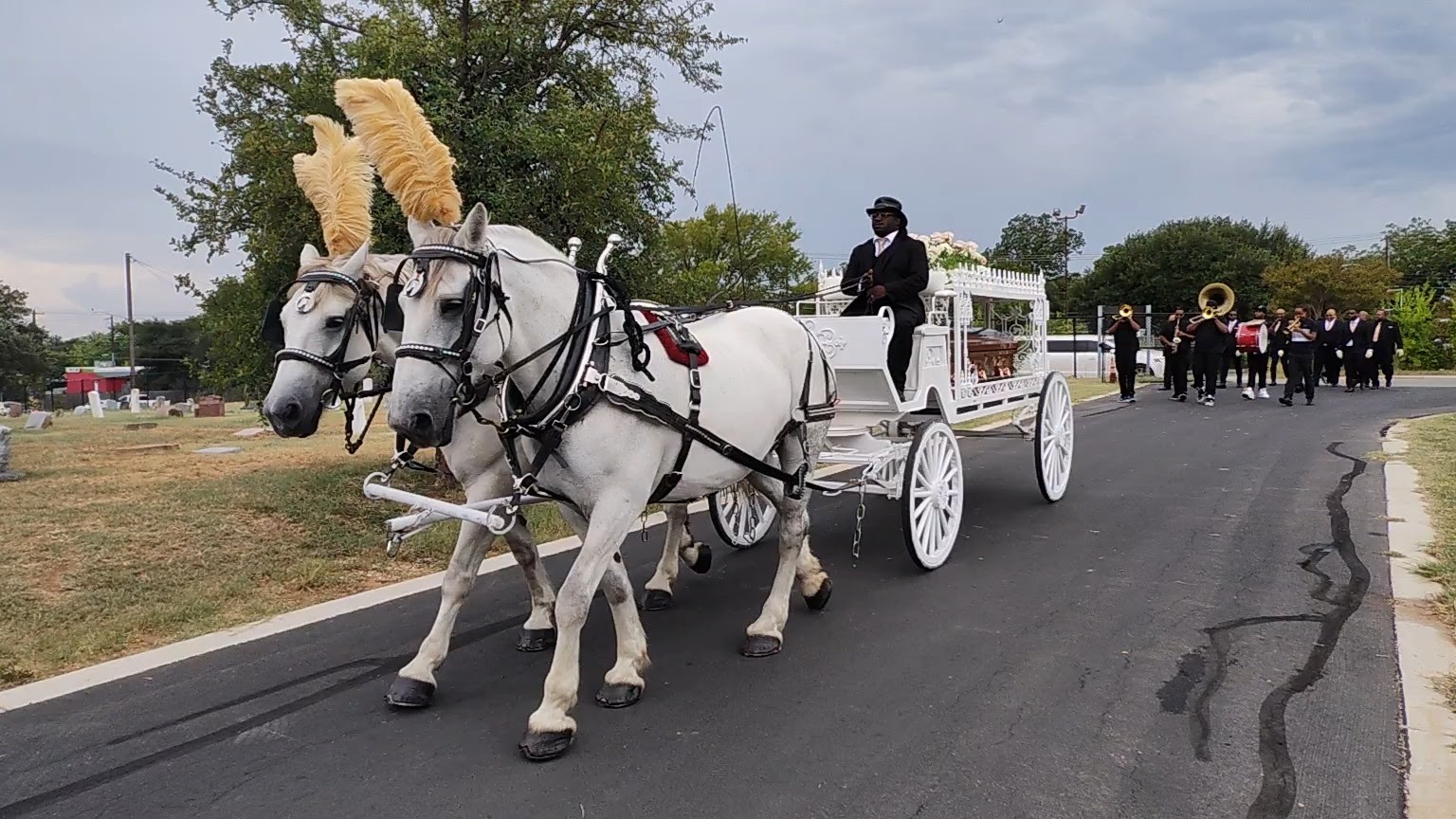
The music moved through East Austin the way jazz always moves — with weight and with joy, with the kind of sound that makes people stop what they are doing and pay attention. Neighbors came out of their houses. People on the street paused. The horses moved at their steady walk, the plumes catching the September light, and behind them the band played her home.
Her Louisiana roots didn't disappear when she moved to Texas — they came with her, shaped her, shaped her children. And on the day her son said goodbye, he brought them back one more time.
The jazz funeral procession at Evergreen Cemetery, Austin, Texas — horse-drawn hearse with custom plumes and a brass band walking behind.
Why This Matters for Texas Families
Texas has its own deep relationship with cultural tradition. San Antonio's Día de los Muertos celebrations are among the most vibrant in the country. The Louisiana diaspora has given Houston and Austin some of their richest musical and culinary culture. The African American church tradition — the homegoing service, the choir, the call and response — has always understood that sending someone to glory is not a quiet affair.
These traditions exist because they work. They give grief somewhere to go. They invite the community in rather than keeping it at a respectful distance. They say, loudly and clearly: this person was here, they mattered, and we are not going to let them leave quietly.
A horse-drawn hearse fits into this tradition naturally. It slows the procession to a human pace. It draws attention the way a jazz band draws attention — not as spectacle, but as invitation. Come look. Come bear witness. Someone who mattered is passing through.
What You Can Ask For
Families sometimes don't know these options exist until they ask. Here is what Texas Funeral Carriage can provide for a celebration-of-life procession:
- A team of white horses rather than a single horse — more formal, more commanding, more presence on the street
- Custom colored plumes in virtually any color to coordinate with your service's palette
- Drivers and attendants dressed in coordinating attire for a fully unified visual
- Coordination with a live band or musicians walking behind the hearse
- Route planning through meaningful neighborhoods or past places your loved one knew and loved
- Slower pace processions that allow the community to gather, stop, and participate
None of these are unusual requests. All of them are available. And all of them can transform a funeral from a ceremony into something that actually feels like the person you are honoring.
Texas Funeral Carriage serves families across San Antonio, Houston, Austin, Dallas-Fort Worth, and all of Texas. We work directly with families and funeral homes to create processions that honor the full life of the person being remembered. Contact us to talk through what's possible.