When families begin planning a funeral, the word that comes up most often — more than any other — is dignity. We want it to be dignified. We want to honor them with dignity. They deserved a dignified send-off.
But ask ten people what a dignified funeral actually looks like, and you'll get ten different answers. Some will say it means a formal service with a traditional casket and flowers. Others will say it means something deeply personal — something that felt like the person who died, not a generic ceremony that could belong to anyone. A few will say they aren't sure, only that they'll know it when they feel it.
That uncertainty is worth sitting with. Because how you define dignity for the person you've lost will shape every decision you make about their farewell — and it matters more than most people realize.
Dignity Is Not Formality
There's a common assumption that a dignified funeral means a formal one. Dark suits. A quiet church. Everything subdued and orderly. And for some people, that is exactly right — it honors who they were and how they moved through the world.
But for many others, a stiff, formal service is almost the opposite of dignifying. It says nothing about them. It could be anyone's funeral. The dignity is surface-level, a performance of solemnity that leaves the family feeling like something important was missed.
"The most dignified thing you can do for someone is to tell the truth about who they were — not just that they existed, but how they lived."
True dignity, in the context of a funeral, is about honoring the full weight of a person's life. Their values. Their passions. The way they made people feel. The things they cared about deeply. When a service reflects all of that — even imperfectly — it feels dignified in a way that no amount of formal staging can replicate.
What Gets in the Way
Planning a funeral under grief is one of the hardest things a family can be asked to do. Decisions that would normally take weeks get compressed into hours. Funeral homes are professional and efficient, but efficiency doesn't always leave room for depth. The path of least resistance is often a standardized package — and standardized packages, by definition, are not personal.
Add to that the well-meaning pressure from extended family members with opinions, the logistics of coordinating out-of-town guests, and the sheer exhaustion of grief itself — and it becomes easy to understand why so many families look back on a funeral and feel like something was missing. Not because anything went wrong. But because there wasn't enough room for who the person actually was.
The families who avoid this regret are usually the ones who made at least one intentional choice — one element of the service that was unmistakably, specifically about the person they were honoring. It doesn't have to be elaborate. It just has to be true.
The Power of Slowness
One of the quietest gifts you can give a grieving family is time. Not more of it — grief doesn't work on a schedule — but the feeling of it. The sense that this moment is not being rushed, that the world has paused briefly to acknowledge that something real has happened.
This is one reason horse-drawn funeral processions have seen such a quiet revival in recent years. A horse-drawn carriage moves at the pace of a walk. It cannot be hurried. It draws attention from everyone it passes — neighbors stop, traffic slows, strangers bow their heads without being asked. For ten or fifteen minutes, the procession creates a kind of public acknowledgment that is almost impossible to manufacture any other way.
Families who have experienced this consistently describe it the same way: it felt real. It felt like something actually happened. The grief had room to breathe. And that, perhaps more than anything else, is what dignity looks like in practice — not the absence of emotion, but the presence of space for it.
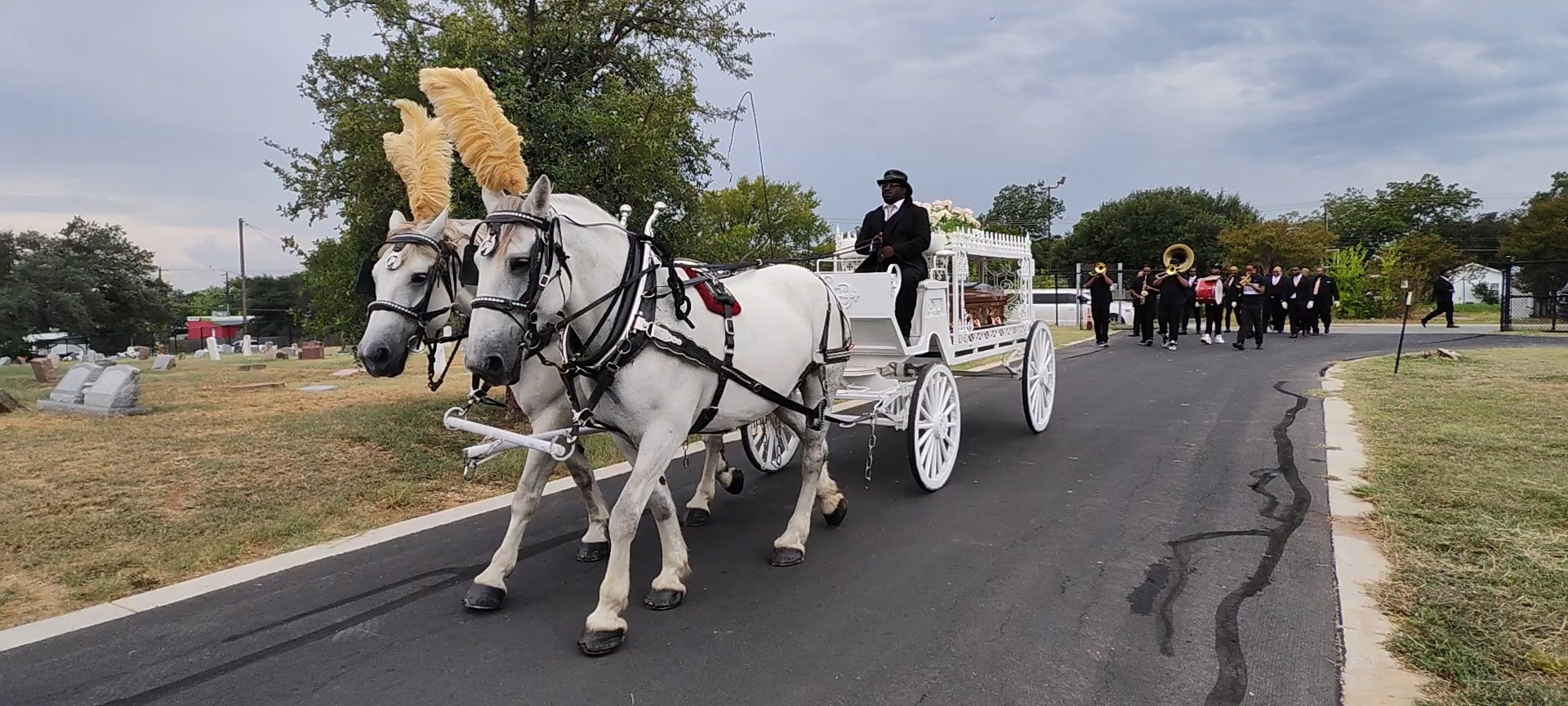
The photo above was taken at Evergreen Cemetery in Austin, Texas, in partnership with Fueller Sheffield Funeral Home on East Martin Luther King Drive. A son wanted his mother's procession to reflect her — not a generic ceremony, but something specifically hers. He chose a full team of white horses rather than a single horse, ordered custom tan plumes dyed to match her funeral's color palette, and our drivers dressed in coordinating colors throughout. The result was a procession that was unmistakably, completely about her.
These kinds of details are available to any family who wants them. Custom colored plumes can be ordered in virtually any color to complement your floral arrangements, casket, or overall color scheme. A team of horses creates a more formal and commanding presence than a single horse — appropriate for larger processions or families who want to make a statement of scale and love. Drivers and attendants can dress in coordinating attire to create a fully unified visual. None of these additions are as complicated as they might seem — and all of them transform a procession from something generic into something that could only ever have belonged to the person you're honoring.
Personalization Is Not Frivolous
Some families hesitate to personalize a funeral because it feels indulgent, or because they worry it might seem disrespectful to tradition. This is worth addressing directly: there is nothing undignified about a funeral that reflects who the person truly was.
We have provided processions where custom colors were incorporated into the carriage decorations to honor a loved one's favorite sports team — and watched the family laugh through tears, because it was so perfectly them. We have provided the riderless horse for veterans whose families said it was the first moment in the whole service that felt like it matched the size of who their loved one was. We have carried people to their rest in ways that made strangers on the street stop and take off their hats.
None of that was frivolous. All of it was dignified — because it was honest.
A Question Worth Asking
If you are planning a service for someone you love, there is one question worth sitting with before you finalize anything: If this person could see their own funeral, would they recognize themselves in it?
Not would they approve of every choice — grief is messy and imperfect and that's okay. But would they see themselves? Would the people who loved them walk away feeling like the service honored the actual person, not just the idea of a person?
If the answer is yes, you've done something important. If you're not sure, it may be worth adding one element — one true thing — that couldn't belong to anyone else.
That is what dignity looks like. And it is available to every family, regardless of budget or tradition or circumstance. It just requires the intention to make it so.
Texas Funeral Carriage serves families across San Antonio, Houston, Austin, Dallas-Fort Worth, and all of Texas. We work with funeral homes and families directly to help create a procession that honors the person who was lost — not just the occasion of their passing. Reach out to us when you're ready.