Some people are defined by the places they feel most at home. For a lot of Texans, that place isn't an office or a living room. It's a pasture at dusk. A barn in the early morning. The back of a horse on a trail no one else knows about. The sound of the land being exactly what it is.
When someone like that dies, the hardest part of planning their funeral is often this: how do you honor a person whose truest self existed outdoors, in relationship with animals and the natural world, in a setting that has absolutely nothing to do with any church or funeral home you've ever walked into?
The answer, for many Texas families, has been a horse-drawn procession. Not because it's dramatic or unusual — though it is both of those things — but because it is simply the most honest tribute available. It brings horses, which many of these people loved above almost everything else, into the farewell itself. And that honesty is the closest thing to dignity that grief can find.
Why Horses Belong in This Farewell
There's something worth saying about what horses actually are, in the context of a funeral. They are alive. They breathe. They are warm and present and responsive in a way that flowers and polished wood are not. When a horse-drawn carriage moves slowly down a road, the horses are not performing — they are simply being what they are. And that aliveness, that presence, creates a quality of moment that nothing manufactured can replicate.
For someone who spent their life working with animals — who understood that horses have their own intelligence, their own moods, their own way of knowing things — having horses present at their farewell is not a metaphor. It's a continuation. It says: the things you loved are here. They came to say goodbye too.
"There is a kind of person who is more themselves outside than anywhere else. A horse-drawn farewell honors that completely."
We have provided processions for ranchers and horse trainers, for wildlife biologists and trail riders, for farmers who never owned a horse but whose entire life was spent in relationship with the land. In every case, the families said the same thing: it finally felt like them.
Who This Kind of Service Is For
You don't have to have owned horses for this to be the right tribute. A horse-drawn funeral procession is a meaningful choice for anyone whose life had a deep connection to:
- Horses — riders, trainers, competitors, breeders, or simply lifelong admirers
- Ranching and agriculture — farmers, cattlemen, and those who worked the land
- The outdoors — hunters, fishermen, hikers, and anyone for whom nature was a sanctuary
- Animals broadly — veterinarians, wildlife workers, rescue volunteers, anyone who devoted themselves to the care of living creatures
- Texas heritage — people for whom the land, the history, and the culture of this state were a source of deep pride and identity
In each of these cases, the horse-drawn carriage is not a theatrical gesture. It is a translation — a way of saying something true about a person in a language that everyone present will understand instinctively, even if they've never seen a procession like this before.
What the Experience Actually Looks Like
Families sometimes worry that a horse-drawn procession will feel out of place in a modern setting, or that logistics will be complicated. In practice, neither of these things tends to be true.
Our horses are trained for ceremonial environments. They are calm in traffic, in crowds, and around the sounds and rhythms of a funeral service. We coordinate directly with the funeral home to integrate the procession seamlessly — the carriage meets the casket, the family gathers, and the procession moves at a walking pace to its destination or to the waiting vehicles for the drive to the cemetery.
What families consistently notice is how the mood shifts the moment the horses appear. Grief is still present — it doesn't go anywhere — but it changes quality. It becomes something more bearable. There's beauty in it. There's something that feels right in a way that's hard to articulate but impossible to miss.
One family in the Hill Country told us afterward that when the horses came around the corner, their father's best friend — a man who hadn't cried yet that whole day — sat down on a curb and wept. Not from sadness, exactly. From recognition. From the feeling that this was the right send-off for the man he had known for forty years.
A True Story: The Cowboy of Falfurrias
A cowboy in deep South Texas made one request before he died. He wanted horses at his funeral. His family made sure of it — and then they went a step further.
In Falfurrias, Texas — a small ranching community in Brooks County, about an hour north of the Rio Grande Valley — we were called to carry a cowboy home. He had lived the way cowboys live: close to the land, close to his animals, with a directness and simplicity that made him the kind of man people don't forget.
His casket was rustic wood, with stirrups for handles. That detail alone said everything about who he was.
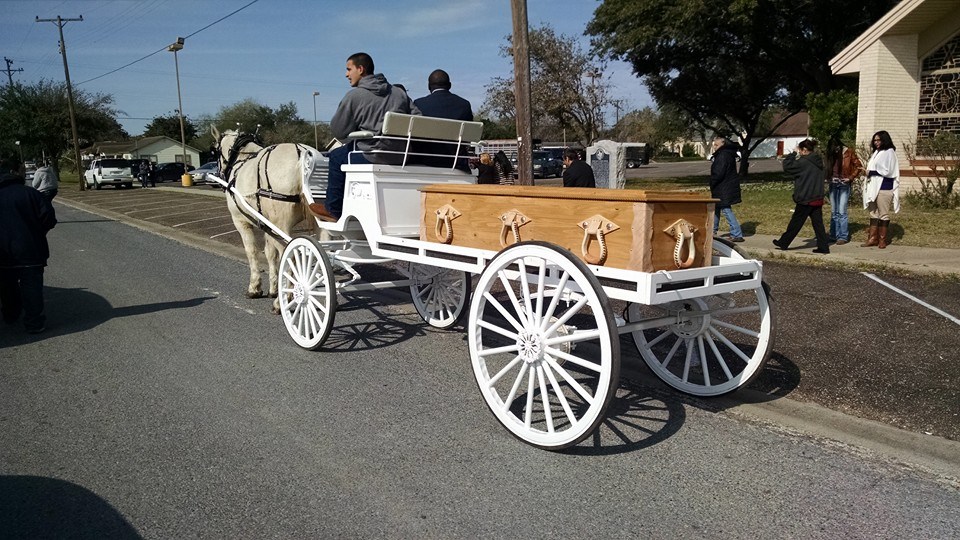
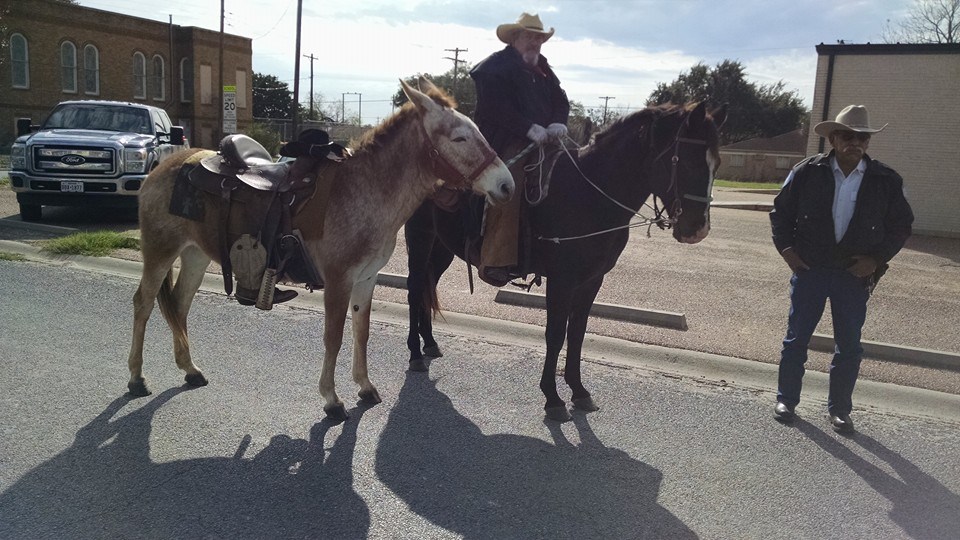
We brought our horse-drawn caisson to carry the casket through the streets of Falfurrias. But the moment that stopped everyone — the moment that made the procession something no one there will ever forget — came when the family introduced the riderless "horse."
Her name was Sister Sarah. She was a donkey. She belonged to a family member and had spent her life, as working animals do, as part of the fabric of the family's daily existence. On this day, she had the honor of walking the procession in the riderless horse tradition — boots reversed, bearing witness to a rider who would ride no more.
In the military tradition, the riderless horse symbolizes a fallen warrior. In Falfurrias that day, Sister Sarah symbolized something just as true: that the animals we love know us in ways other people sometimes can't, and that their presence at a farewell carries a kind of grief and loyalty that needs no translation.
"Sister Sarah walked that procession like she understood every bit of what was happening. Maybe she did."
This is what we mean when we talk about personalized tributes. The tradition of the riderless horse exists because it is honest — it reflects something real about the person being honored. Sister Sarah was honest in exactly that way. She was real. She was theirs. And she was there.
The service was arranged in coordination with the family and Alaniz Funeral Home in Falfurrias. It is one of the services we are most proud to have been part of.
Personalizing the Tribute
For someone with a deep connection to animals or the outdoors, there are many ways to make the procession more specifically theirs:
- Incorporate their favorite colors into the carriage decorations or floral arrangements
- Choose a route that passes a place that mattered to them — a ranch, a trail head, a property they loved
- Include the riderless horse alongside the carriage as a symbol of their horsemanship or their service
- Ask us about using their own saddle or tack in the ceremony if they were a rider
- Coordinate with family to have guests walk alongside rather than drive — making the procession something everyone participates in together
None of these additions are complicated. All of them transform a funeral from an event into an experience — something the people present will carry with them long after the day is over.
A Note on Texas
There is something particular about doing this in Texas. This state has a relationship with horses and land that goes back centuries — through indigenous peoples, through Spanish colonial ranching traditions, through the cattle drives and the working ranches that shaped the entire region. When a horse-drawn carriage moves down a Texas road, it is not an anachronism. It belongs here. It always has.
For families honoring someone whose identity was rooted in Texas — its landscape, its animals, its way of life — a horse-drawn procession carries that history quietly alongside it. It says: this person was part of something larger than themselves. And that something is still here.
Texas Funeral Carriage serves families across San Antonio, Houston, Austin, Dallas-Fort Worth, the Hill Country, and all of Texas. If you are honoring someone with a deep connection to animals, horses, or the land, we would be honored to be part of their farewell. Contact us to talk through what's possible.