There is a moment in a military funeral procession that stops people cold. The caisson moves slowly, the family follows behind, and then — walking alongside — a horse with an empty saddle. Boots reversed in the stirrups, facing backward. No rider. Just the horse, and the weight of what that means.
If you have never seen a riderless horse at a funeral before, it is the kind of image that stays with you. And if you are planning a service for a veteran or someone who served, understanding what this tradition means — and where it comes from — can help you decide whether it belongs in their farewell.
Where Does the Tradition Come From?
The riderless horse has been part of military funeral ceremony for centuries. Its origins are often traced back to Genghis Khan, who had his horse sacrificed at his burial so it could carry him into the afterlife. The tradition migrated through military cultures across Central Asia and Europe, eventually becoming formalized in Western military ceremony by the 19th century.
In the United States, the riderless horse — called a caparisoned horse in formal military protocol — became an iconic part of state and military funerals. Most Americans remember the image from President John F. Kennedy's 1963 funeral procession in Washington, D.C., where a black horse named Black Jack walked behind the caisson carrying the President's casket. Black Jack reportedly struggled to be restrained, as if sensing the gravity of the moment. That image was seen by millions and permanently cemented the riderless horse in the American memory as a symbol of profound loss.
"The empty saddle speaks what words cannot — that someone who rode through life with courage and purpose will ride no more."
The reversed boots in the stirrups carry their own meaning. Facing backward, they symbolize a warrior looking back over the life they lived — and saying goodbye to the world they are leaving behind. It is a gesture both mournful and deeply respectful, a visual acknowledgment that this person faced forward in life and now faces back in death.
Who Is It For?
Traditionally, the riderless horse is associated with military funerals — particularly for officers, veterans, and those who held positions of significant rank or service. Full military honors at Arlington National Cemetery include the caparisoned horse as part of the formal procession.
But the tradition is not limited to the military. Over the years, the riderless horse has been used at the funerals of civilians who had a deep connection to horses — riders, ranchers, horse trainers, and anyone for whom a horse was a meaningful part of their life. The symbolism translates beautifully: the horse that carried them in life now walks on without them.
In Texas, where horsemanship, ranching, and military service are woven deeply into the culture, the riderless horse finds a natural home. We have provided this service for veterans across San Antonio, Houston, Austin, and Dallas-Fort Worth, as well as for civilians whose families felt the empty saddle was the truest way to say who their loved one was.
A True Story: The Team Roper of Jourdanton
In Atascosa County, we helped a family say goodbye to a team roper the only way that made sense — with his horse, his family, and a procession through the town that knew him.
In Jourdanton, Texas — the seat of Atascosa County, deep in South Texas ranch country — we were called to carry a team roper home.
The procession began at St. Matthew's Catholic Church and wound its way to the cemetery through a community that knew this man the way small towns know their own. He had spent his life in the arena and on the land. His roping horse knew him the way a working animal knows the person who rides them every day — by habit, by feel, by a thousand hours of shared work.
That horse led the procession as the riderless horse.
Behind the horse-drawn hearse, his roping partner walked without a rider — boots reversed, saddle empty — not as a symbol borrowed from military tradition, but as something more personal and more immediate. This was his horse. The one that had run beside him in the arena. The one that knew his weight in the saddle and the sound of his voice. And now it walked on without him, exactly as it should.
"His grandson rode on the hearse. His son rode the horse that led the riderless horse. Three generations, one procession, one man honored completely."
His grandson rode on the hearse itself — a detail that brought the family into the procession in a way that no limousine or flower car ever could. His son rode the lead horse, guiding the riderless one behind. Three generations moved together through the streets of Jourdanton, and everyone who watched from the sidewalks understood exactly what they were seeing.
The service was arranged in partnership with Patrick Hurley of Hurley Funeral Home in Pleasanton, Texas — a funeral home that understood what this family needed and made sure they got it. It is the kind of collaboration we are grateful for, and the kind of service we are proud to have been part of.
This is what the riderless horse looks like when it is done right. Not a ceremony borrowed from a protocol manual, but a tribute that grew directly from who the person was. His horse. His family. His land. His final ride.
What to Expect
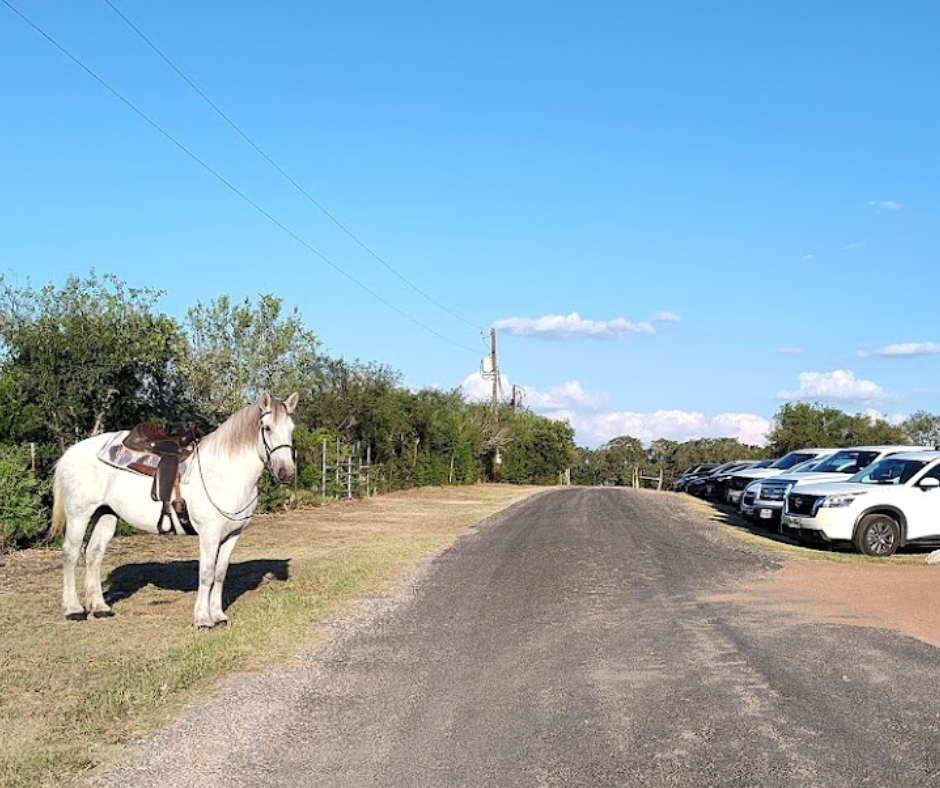
A riderless horse is handled by an experienced handler who walks alongside the horse throughout the procession. The horse is calm, trained for ceremonial settings, and accustomed to the sounds, crowds, and solemnity of funeral environments. The boots — traditionally the rider's own boots if available, or ceremonial boots — are placed in the stirrups and reversed before the procession begins.
The horse walks in silence. There is no performance to it, no display. It is simply present — and that presence is enough. Families who have chosen this element consistently say it was the moment that moved them most, and the moment their guests remembered longest.
A Word About Meaning
We live in an era of fast funerals. Efficient, scheduled, coordinated — and often over before grief has had a chance to breathe. The riderless horse is the opposite of that. It slows everything down. It draws eyes and stills noise. Neighbors stop on their porches. Strangers bow their heads. For a few minutes, everyone present is reminded that a real person lived and mattered and is gone.
That is not a small thing. In fact, it may be the most important thing a funeral can do.
If you are honoring a veteran, a soldier, a rancher, or simply someone who loved horses and the land — the riderless horse may be the most honest tribute you can offer. Not because it is dramatic, but because it is true. The saddle is empty. The boots face backward. And everyone who sees it understands exactly what that means.
A horse-drawn hearse and riderless horse procession by Texas Funeral Carriage — White Horse & Carriage Company.
Texas Funeral Carriage provides riderless horse services for families across San Antonio, Houston, Austin, Dallas-Fort Worth, and surrounding communities. We work directly with funeral homes and families to incorporate this element seamlessly into your procession. Contact us to learn more.